
Everyone in tape-ball cricket wants the ball to move. Hardly anyone is taught why it moves. The good news is that swing is not a gift — it is a set of mechanical choices you make before you run in, and once you understand them you can repeat them.
This guide covers the grip, the seam angle, which side to keep smooth, why your ball stops swinging halfway through a session, and the drills that turn all of it into a habit.
Why a ball swings at all
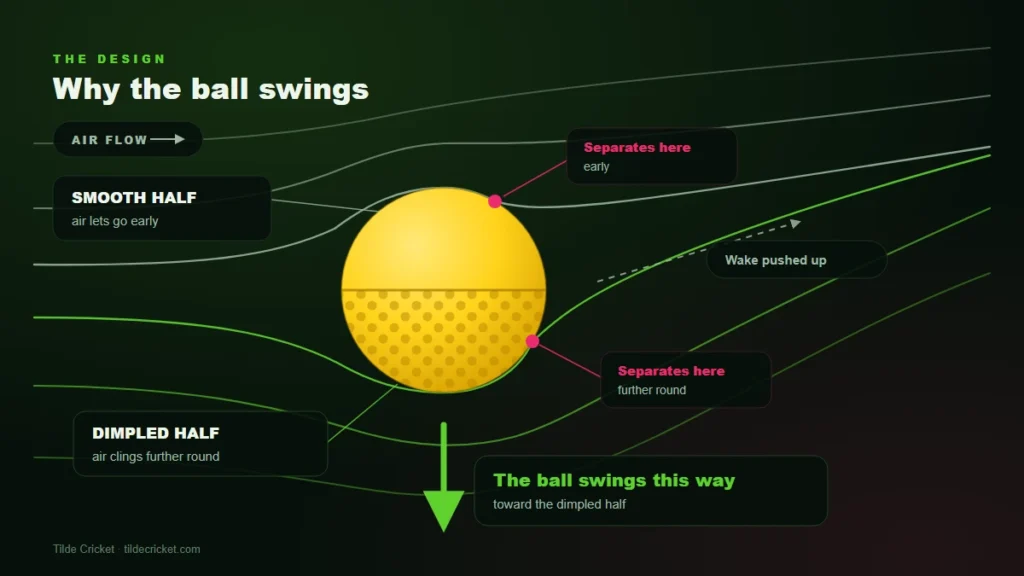
A ball swings when the air coming off one side of it behaves differently from the air coming off the other.
Over a smooth surface, air flows cleanly and then peels away from the ball early. Over a rough surface, the air gets churned up and clings to the ball for longer before it separates. Because the air lets go at different points on either side, the ball is pushed sideways in flight — towards the rougher side.
That is the whole secret. Every swing technique is just a way of making one side of the ball behave differently from the other, and then pointing the ball so the sideways push goes where you want it.
The grip
Start here, because a bad grip undoes everything else.
- Two fingers either side of the seam. Index and middle finger sit on top, close together, with the seam running between them.
- Thumb underneath, on the seam. It steadies the ball. It should not be squeezing.
- Hold it in your finger pads, not your palm. If the ball is buried in your hand you lose all wrist snap and the seam wobbles.
- Grip loosely. This is the one most club bowlers get wrong. A tight grip tenses the forearm, the wrist stops working, and the ball comes out scrambled. Hold it like you would hold a full cup of chai you do not want to spill.
Outswing and inswing: the seam does the aiming
With the grip set, the direction of swing comes from two things — the angle of the seam and which side of the ball is rough.
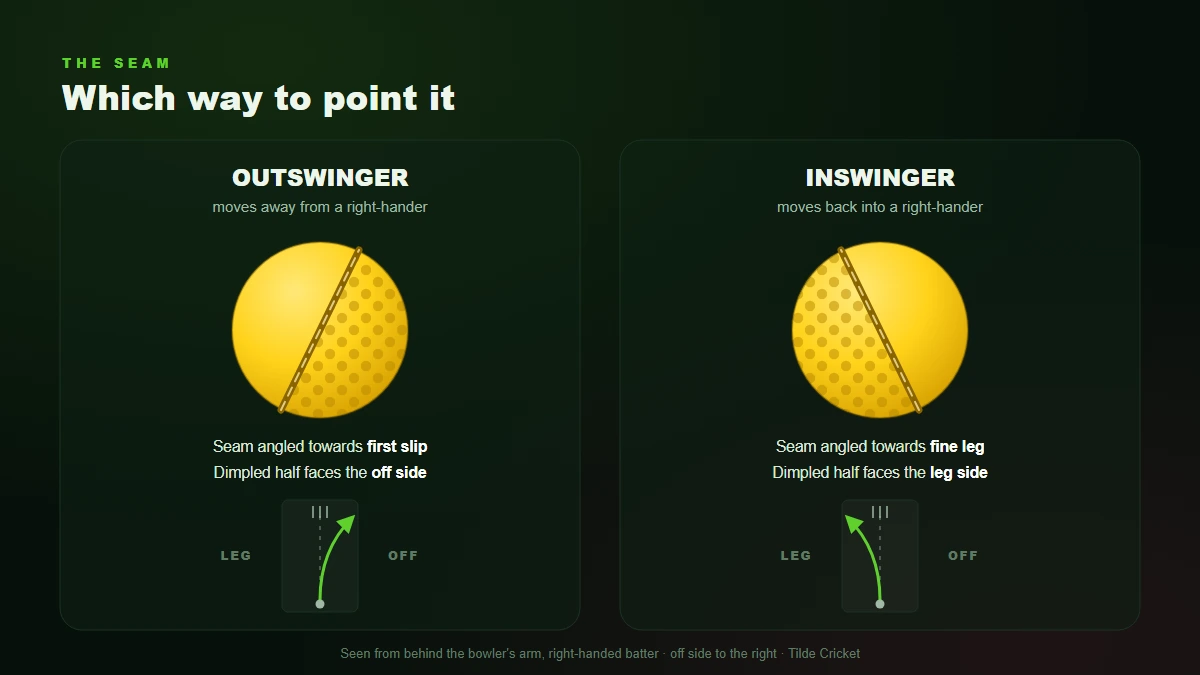
For an outswinger (moving away from a right-handed batter, towards the slips):
- Angle the seam towards first slip.
- Keep the rough side facing the off side.
- Wrist stays behind the ball at release, fingers pulling down the back of it.
For an inswinger (moving back into a right-handed batter):
- Angle the seam towards fine leg.
- Keep the rough side facing the leg side.
- Same wrist, same release — only the seam angle and the ball’s orientation change.
Notice what is not on those lists: changing your action. Bowlers lose far more swing by trying to muscle the ball than they ever gain. Set the seam, keep the action identical, and let the air do the work. It also means the batter cannot read you out of the hand.
The tape-ball problem
Here is where tape-ball cricket makes life hard. A freshly taped tennis ball is smooth all the way round, so there is no rough side to swing towards. What little movement you get comes from the ridge where the tape overlaps, and from the small asymmetry in how the tape was wound.
Then, over about twenty-five overs, three things happen:
- The tape scuffs and lifts, usually unevenly.
- The ball goes slightly out of round, so the bounce stops being predictable.
- Somebody re-tapes it mid-session, and whatever asymmetry you had learned to use is gone.
That is why most tape-ball bowlers can swing the ball brilliantly for twenty minutes and then spend the rest of the night wondering what changed. You are not losing your action. You are losing the ball.
Islamabad
Want a ball that still swings in the fortieth over?
The Tilde swing ball is 70g PU rubber — tape-ball weight — with one dimpled half and one smooth half built into the surface. There is no tape to wear off, and it is tested for 200+ overs.
Swinging a ball with no tape on it
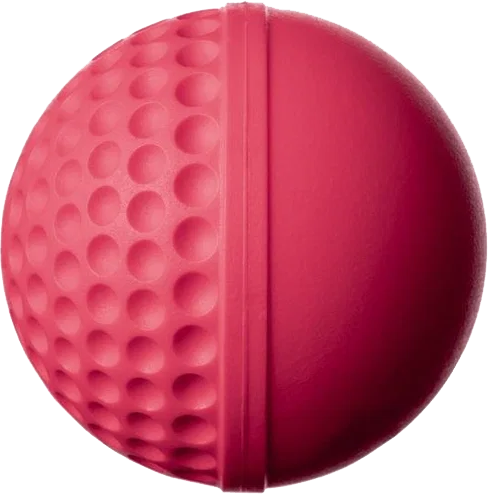
A purpose-built swing ball solves the problem a different way: instead of relying on tape wearing unevenly, the two faces are different by design. One half is dimpled, one half is smooth, and that difference does not wash out after twenty overs.
The technique is the same as above, with one simple rule: point the dimpled half in the direction you want the ball to move. Dimpled side facing the off side gives you the one that leaves the right-hander; turn the ball over and you have the one that comes back in. Bowl six of each and watch what actually happens before you trust it in a match — every bowler’s release puts a slightly different tilt on the ball.
This is the whole idea behind the Tilde swing ball, and behind the imported technique balls it is based on — though those are built at 146g–156g for hardball practice, which is a different game from the one most of us play. There is a side-by-side comparison here if you want the detail.
What about reverse swing?
Reverse swing happens when the ball is travelling fast enough, and one side is rough enough, that the airflow goes turbulent on both sides. At that point the usual rule flips and the ball moves towards the smoother side instead.
Two honest notes. First, it needs genuine pace — most club bowlers are nowhere near the speed where conventional swing stops working. Second, in tape-ball cricket a lot of what gets called reverse swing is really just an old, battered, lopsided ball doing something unpredictable. That is good fun, but it is not a skill you can repeat on demand.
If you want to work on it properly, get the basics of conventional swing both ways first. Reverse is a refinement, not a shortcut.
Four drills that actually groove it
- One stump, six balls. Put a single stump on a good length. Bowl six outswingers, then six inswingers. You are not chasing the stump — you are watching whether the ball moves the same way every time.
- Mark the smooth side. Put a dot on one face with a marker. Now you can see from behind the arm whether you are actually presenting the ball the way you think you are.
- Film one over from directly behind. Your phone on the ground behind the stumps tells you more in six balls than an hour of advice. Look at the seam: is it upright and steady, or rolling in the air?
- The no-run-up test. Bowl ten balls off two steps. If it stops swinging when you take the pace off, your swing was coming from the ball, not from you — fix the seam position first.
Not sure whether yellow or pink reads better under your ground’s lights? Call or WhatsApp us and we will tell you what the grounds in your area are using — +92 320 982 2595.
Five mistakes that kill swing
- Squeezing the ball. Tension in the hand becomes a wobbling seam.
- Falling away at the crease. If your head and front shoulder drift towards fine leg, the ball is released across itself and the seam never stays upright.
- Bowling flat out. Swing needs air time. Most bowlers swing the ball best at about eighty percent effort.
- Polishing both sides. If both faces are the same, there is nothing for the air to argue with. Shine one side only.
- Pitching too short. A swinging ball that lands short has finished moving before it reaches the bat. Pitch it up — swing and a full length are a package.
Where to practise it
Swing is easiest to learn somewhere with consistent conditions, which in practice means nets or an indoor ground rather than an open field with a crosswind. If you are in the twin cities, we have mapped out the indoor and box cricket grounds in Islamabad and Rawalpindi, with phone numbers for booking.
FAQ
Can you swing a tennis ball without any tape?
Yes, but not reliably — a bare tennis ball is fuzzy on all sides and light enough that the wind matters more than your seam. Tape makes it heavier and gives it a smooth face. A purpose-built swing ball skips the step by having two different faces from the start.
Which side should be shiny — the side I want it to swing towards?
The opposite. The ball moves towards the rougher side, so keep the shine on the side you want it to move away from.
Why did my ball swing for twenty overs and then stop?
Almost always the tape. Once it scuffs unevenly and the ball goes out of round, the surface you learned to bowl with no longer exists.
Do I need to bowl fast to swing it?
No. Conventional swing works at club pace, and often works better slightly below your maximum because the ball spends longer in the air. Reverse swing is the one that needs real speed.
How heavy should a tape ball be?
A taped tennis ball comes out around 70 grams — a tennis ball plus the weight of its tape. That is light enough to be safe on tape-ball bats, hands and indoor nets, and it is the weight tape-ball cricket is played at.
Every Tilde ball is tested for 200+ overs with no re-taping, in yellow or pink, at senior men’s ball size.
Call +92 320 982 2595
See the swing ball
Tilde Cricket
PU-rubber swing balls for tape ball, indoor grounds and night nets
Serving Islamabad · Orders by call and WhatsApp
Rs 700 for one ball · Rs 2,000 for three · Rs 4,000 for six
Running a ground or academy? Trade pricing by the box