
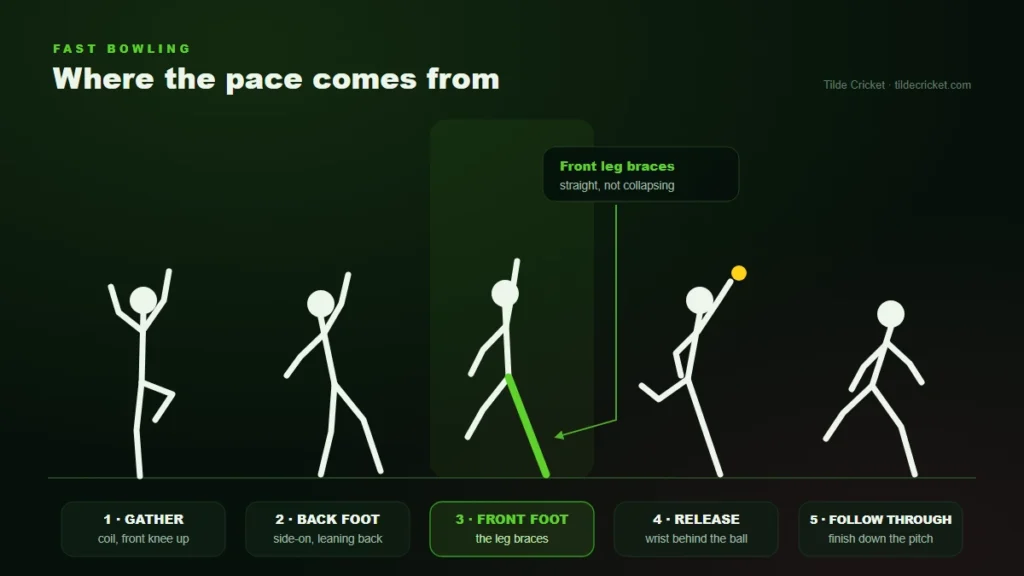
Every tape-ball bowler wants another yard of pace. Most go looking for it in the wrong place — a longer run-up, a bigger heave at the crease, more effort through the arm. Pace does not come from effort. It comes from a short chain of positions that let the speed you already have reach the ball instead of leaking out sideways.
Here is where the speed actually comes from, and what to practise.
1. The run-up: rhythm beats distance
A run-up has one job — to arrive at the crease balanced, with momentum going straight down the pitch. Longer is not faster. Most quick bowlers use between twelve and eighteen steps, and plenty of club bowlers are faster off fourteen than off twenty-five, because the last four strides are the only ones that matter.
- Accelerate gradually. Start relaxed, build into the crease. Sprinting from step one leaves you nothing at the end.
- Mark it and keep it. Pace off a consistent run-up, no-balls off a guessed one.
- Run tall. Leaning back slows you down and drops your release point.
2. The front leg: the biggest single source of pace
This is the one most club bowlers never think about, and it is worth more than everything else combined.
When your front foot lands, that leg should brace — straighten and hold firm rather than collapsing at the knee. A braced front leg stops the lower half of your body dead, and all that momentum has nowhere to go but up through your trunk and out through the bowling arm. It is the same principle as a whip: the handle stops, the tip accelerates.
A soft, bending front knee absorbs the energy instead. The bowler feels like they are working hard — and the ball comes out slow.
3. Hip–shoulder separation
At the moment the front foot lands, your hips should have started turning towards the batter while your shoulders are still side-on. That twist between hips and shoulders loads the trunk like a spring, and it unwinds through the delivery.
If your hips and shoulders rotate together, there is no spring. This is the difference between an arm bowler and a fast bowler, and it is coachable.
4. A long, fast arm and a snapping wrist
The bowling arm should travel through a big circle, not a short chop. Keep it relaxed — a tense arm is a slow arm. The last thing to happen is the wrist, which snaps down behind the ball at release. That snap is worth real speed and costs nothing but practice.
Keep the wrist behind the ball rather than beside it. A wrist falling away to the side is where pace goes to die, and it scrambles the seam too, which costs you any swing you were hoping for.
5. Follow through properly
Bowlers who pull out of the action after release are decelerating before it. Finish down the pitch, let the bowling arm carry across the body, and take four or five strides after delivery. A full follow-through is also easier on your back than a sudden stop.
Islamabad
Working on your pace? Stop re-taping between overs.
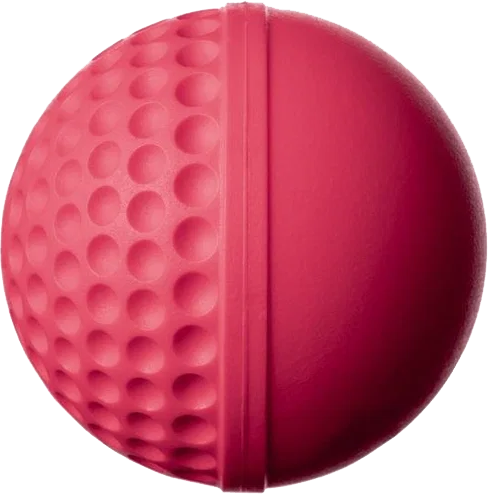
The Tilde swing ball is 70g PU rubber at senior men’s ball size, so it feels right in the hand and fits a bowling machine or wanger — and it is tested for 200+ overs, which is a lot of sessions from one ball.
Six drills that build pace
- Walk-in deliveries. Bowl twenty balls off four steps, concentrating only on the braced front leg. Slow approach, full effort through the crease. This isolates the one thing that matters most.
- Side-on wall drill. Stand side-on an arm’s length from a wall, front arm pulled down hard, bowling arm brushing past your ear. Ten slow repetitions teaches the shape without a ball.
- Medicine-ball slams. Overhead slam, then a rotational throw into a wall from side-on. Three sets of eight. This trains the trunk to unwind fast, which is exactly what hip–shoulder separation needs.
- Sprint work. Six to eight 30-metre sprints, full recovery between them. Run-up speed is run speed — there is no shortcut around being fit.
- Single-stump target sets. Six balls at one stump on a good length, at match pace. Speed without control is just a wide.
- Film from side-on. Phone on the ground, level with the crease. Look for two things: does the front knee bend, and are the shoulders still side-on when the front foot lands?
How to check your speed with a phone
You do not need a speed gun. Film the delivery from side-on at the highest frame rate your phone offers, measure the distance from the crease to the stumps, and count the frames from release to the ball reaching the stumps. Divide the distance by the time those frames represent.
A few of the free cricket speed apps do this automatically from a video. They are not precise to the kilometre, but they are consistent enough to tell you whether a change in your action is working, which is the only thing you actually need.
And a dose of realism: senior club tape-ball bowlers generally sit somewhere between 100 and 125 km/h. Anyone promising you Shoaib Akhtar’s 161 is selling something.
Training at a ground that goes through a bag of tape balls a week? Ask about trade pricing by the box — +92 320 982 2595.
Look after your back
Fast bowling loads the lower back hard, and the highest-risk pattern is the mixed action — hips front-on while the shoulders are side-on, forcing the spine to twist and hyperextend at the same time. Film yourself: if your chest is opening up to the batter while your feet are still side-on, get a coach to look at it before you add pace.
Two sensible rules whatever your action. Build your bowling volume up gradually rather than in jumps, and if you are a teenager still growing, keep a close eye on how many overs you bowl in a week. Pain in the lower back that does not settle after a few days is worth having looked at.
Does the ball make a difference?
Not to your speed, no — but it makes a large difference to your practice. A tape ball lasts roughly twenty-five overs before the tape lifts, the ball goes out of round and the bounce drifts. Halfway through a session you are no longer practising on the same ball you started with, which makes it very hard to tell whether a change in your action helped.
What you want for pace work is something that stays the same for the whole session: a consistent weight at around 70 grams so it feels like the ball you play matches with, senior men’s size so it fits a bowling machine or wanger, and a surface that does not need stopping to repair. That is what the Tilde ball is built to do — tested for 200+ overs with no re-taping, in yellow or pink.
If you need somewhere with consistent conditions to do this work, the indoor and box cricket grounds in Islamabad and Rawalpindi are listed here, with phone numbers.
FAQ
How can I increase my bowling speed quickly?
The fastest single gain for most club bowlers is bracing the front leg instead of letting the knee collapse. Nothing else returns as much for as little technical change.
Does a longer run-up make you faster?
Only up to a point. Beyond about eighteen steps most bowlers gain nothing and arrive at the crease less balanced. Rhythm matters more than distance.
Can I practise fast bowling at home?
Yes. The wall drill, medicine-ball work, sprints and run-up rhythm all need no net and no ball. They are also the parts most bowlers skip.
How do I bowl fast with a tennis or tape ball?
Exactly the same mechanics. A lighter ball punishes a poor wrist position more, because there is less mass to carry a scrambled release — so the wrist snap matters even more.
What is a good tape-ball bowling speed?
Most senior club bowlers land between 100 and 125 km/h. Consistency and control will take more wickets at that level than raw pace.
Every Tilde ball is tested for 200+ overs with no re-taping, at senior men’s ball size, in yellow or pink.
Call +92 320 982 2595
See the swing ball
Tilde Cricket
PU-rubber swing balls for tape ball, indoor grounds and night nets
Serving Islamabad · Orders by call and WhatsApp
Rs 700 for one ball · Rs 2,000 for three · Rs 4,000 for six
Running a ground or academy? Trade pricing by the box